Yo, if you’ve ever wondered how those mobile fuel trucks rolling up to your construction site, farm, or emergency job site actually make sure they’re not shorting you on gas—let’s cut the technical jargon and break it down straight. I’ve been selling mobile fuel stations for over 8 years now, and I can’t tell you how many times a guy in a dirty hard hat has leaned on my truck and asked, “How do I know you’re giving me what you say you are?” Fair question, right? No one wants to pay for fuel they never get, especially when you’re operating 10 pieces of heavy gear that all guzzle gas like it’s going out of style. Mobile Fuel Station

First off, let’s get one thing clear: we don’t “guess” fuel quantity. That’s a disaster waiting to happen, both for us and for our customers, because even a 10-gallon discrepancy on a 1000-gallon load can turn into a whole headache of calls and complaints. Every mobile fuel station we build (and yeah, I sell ’em, so I’ve got skin in this game) has built-in measurement tools that are regulated—like, actually government-regulated in most states, not just some random sensor we stuck on a pipe.
Let’s start with the heart of the whole operation: the on-board tank. That’s the big metal tank on the back of the truck, and it’s not just a generic trash can for gas. It’s calibrated. Before we even put a drop of fuel in it, we run a test to map every single inch of its interior. That means we have a chart (we call it a strapping chart, because that’s exactly what it is—we “strap” the tank to measure volume at every height) that tells us, if the tank is 12 inches full, that’s 150 gallons; 24 inches is 320 gallons, and so on, all the way up to the max fill level. No fuzz there—this is the same process gas stations use for their underground tanks, so it’s not some trick we made up.
But just relying on the tank’s strapping chart isn’t enough. Tanks slosh, right? If we’re driving on a bumpy road to your job site, the fuel moves around, and a stick stuck in the tank might give a wrong reading because the fuel’s not sitting flat. That’s why we use electronic level sensors, not just a dipstick (though we still keep a manual dipstick as a backup, don’t worry). The sensors we use are ultrasonic, not the flimsy ones you find on a cheap portable gas can. Ultrasonic means it sends a sound wave down to the fuel, times how long it takes to bounce back, and calculates the height super precisely—within a tenth of an inch, actually. That way, even if the truck’s leaning a little when we park, or the fuel’s sloshing from the ride, the sensor can adjust for that slosh over a few seconds and give a stable, accurate reading.
Wait, but what about when we’re pumping fuel into your machine or generator? That’s when the real test happens, right? If the tank says we’ve got 500 gallons when we show up, and we pump 100 gallons into your excavator, the truck’s meter should say we’re down 100 gallons. Here’s where the flow meter comes in—another non-negotiable piece of kit. I once bought a used mobile fuel truck for a side gig back in 2016 that had a cheap flow meter; after a week, we realized it was off by 15% because it was just a little gear that spun and guessed. Now every system we sell has a turbine flow meter, no exceptions. What’s a turbine flow meter? Picture a little fan inside the fuel line. When fuel flows through, it spins the fan, and the faster it spins, the more fuel’s moving. The sensor counts the spins, converts that to volume, and bam—you’ve got exact gallons pumped. These things are calibrated every single year by third-party companies, so even if a state inspector stops by and asks for proof, we can hand them a sticker that says “calibrated to NIST standards” (that’s the National Institute of Standards and Technology, the guys who set the rules for all measurements in the US). No cutting corners here—if the flow meter’s off, we’re out of compliance, and that’s a huge fine.
But let’s talk about the little stuff people don’t think about, because that’s where mistakes happen. For example: temperature. Fuel expands when it’s hot, shrinks when it’s cold. If you show up to a job site in Texas in July, and our truck’s fuel was sitting in the 90-degree sun for 8 hours, that fuel’s warmer than it would be in your machine, which is sitting in the sun too, but maybe not as long. We have temperature sensors on both the truck’s tank and the fuel line when we pump, so we adjust the volume for temperature. Wait, that sounds fancy, but it’s actually simple math—like, fuel has a coefficient of expansion, so for every degree above or below 60 degrees Fahrenheit, it changes by about 0.05% per degree. So if fuel’s 100 degrees, that’s 2% more volume than it would be at 60, so we subtract 2% to get the “standard” gallon that you’re supposed to pay for, not the warm, expanded one. That’s a big one because a lot of people get confused when we say the meter says we pumped 105 gallons but your machine’s tank only holds 100—because the fuel expanded in the heat, so when it cools down in your tank, it’ll only be 100. We always explain that upfront so no one’s caught off guard.
Another thing we do: log every single reading. The on-board system keeps a timestamped record of how much fuel was in the tank when we showed up, how much we pumped, the temperature, even the location of the job site. So if a customer says, “Hey, you said you pumped 200 gallons but my log only shows 180,” we can pull up that log, cross-check it with our flow meter data, and be on site in 20 minutes to verify. No arguing, no he-said-she-said—just facts. I can’t tell you how many times that log has saved us from a bad deal; once, a guy tried to say we shorted him 50 gallons, but our log showed we pumped exactly 500 gallons, and his machine’s fuel log from that day matched up when he checked it. He apologized later, but that’s why the logging is non-negotiable.
Wait, what about when we’re refilling the mobile fuel station’s tank at our yard? We don’t just pump from a big gas station hose and go. We use the same turbine flow meter there, too, and we cross-check it with the station’s own meter. So when we leave our yard, we already know exactly how much fuel is in our truck, down to the gallon. No surprises. If the station’s meter is off, we point it out—we’re not going to load up a truck with bad numbers, because that’s our reputation on the line.
I know some guys might think, “This is all a lot of work just to sell fuel,” but here’s the thing: if we cut corners on measurement, we don’t get repeat customers. Construction sites run on reliable fuel, farmers need their tractors running during planting season, emergency services need fuel when there’s a storm—if we mess up the measurement, we mess up their whole operation. That’s why every mobile fuel station we supply has these systems, no exceptions. We don’t sell the cheap ones that use a dipstick and a guess; we sell the ones that pass every state inspection, that have third-party calibration, that can back up every gallon with data.
Let me give you a real example from last month. A construction company in Dallas hit us up panicking on a Friday afternoon—their main fuel truck broke down, and they had 3 excavators and a paving crew waiting on fuel to finish a job before the weekend rain hit. We showed up with our mobile station, set up, and the foreman was hovering by the pump the whole time, watching like a hawk. We explained all the measurement stuff to him, showed him the ultrasonic sensor reading, the flow meter display, and even let him hold the manual dipstick to check. When we were done pumping, the log said exactly 450 gallons, which matched their machine’s fuel tank capacity. He texted his office, got confirmation, and tipped our driver $20 because he said he didn’t have to worry about getting scammed. That’s the kind of customer we want—someone who knows we’re transparent about how we measure fuel.
So to wrap this up: no, we don’t just guess. We use calibrated tanks with strapping charts, ultrasonic level sensors to account for slosh and terrain, turbine flow meters calibrated to government standards, temperature adjustments for expansion/contraction, and timestamped logs for every transaction. Every part of the system is set up to make sure you get exactly what you pay for, every single time.
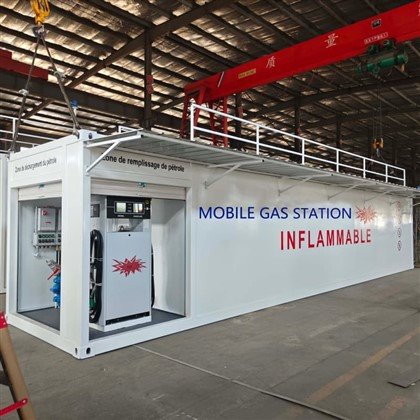
If you’re a contractor, farmer, property manager, or anyone who needs reliable, on-demand fuel without the hassle of running to a gas station, we’ve got mobile fuel stations built with all these measurement tools. No cheap shortcuts, no vague promises—just exact, transparent measurements so you can focus on running your operation, not arguing about fuel quantities. Reach out to us if you want to chat more about how our systems work, or if you’re ready to get set up with a mobile fuel station for your business.
Skid-mounted Refueling Unit References:
- National Institute of Standards and Technology. (2020). Handbook 130: Specifications, Tolerances, and Other Technical Requirements for Weighing and Measuring Devices.
- American Petroleum Institute. (2018). Standard 2555: Measurement of Fuel in Portable and Stationary Tanks.
- U.S. Department of Transportation. (2021). Federal Motor Carrier Safety Administration Regulations for Commercial Fuel Transport Vehicles.
Shandong Jingcai Industry and Trade Co., Ltd.
As one of the most professional mobile fuel station manufacturers and suppliers in China, we also support customized service. With abundant experience, we warmly welcome you to wholesale high quality mobile fuel station in stock here from our factory. Contact us for free sample.
Address: Caojiazhuang Village Industrial Park, Lingcheng Town, Qufu City, Jining City, Shandong Province.
E-mail: shandongjingcai888@gmail.com
WebSite: https://www.sdjingcaicn.com/
